
Quelle quantité de mélatonine dois-je prendre pour mieux dormir ?
Posté par Vitasunn le 15 mai 2025
Key Takeaways:
- 1 - 5 mg is the typical melatonin adult dosage range.
- Beginners may start with 0.5 mg.
- Melatonin dosage varies by sleep severity and product format.
- 10 mg is generally considered the maximum safe melatonin dose.
- Melatonin overdose may induce adverse effects.
- There are drug interactions to beware of too.
Melatonin is one of the most effective sleep aids available. This supplement utilizes the same biological mechanism as the eponymous natural hormone, signaling the body to sleep when darkness falls.
Numerous studies have found Melatonin to be remarkably effective against various sleep disorders. In a previous experiment, researchers noted a marked reduction in the average sleep onset latency for subjects who took supplemental Melatonin compared to the placebo group.
However, Melatonin’s efficacy largely depends on the serving portions. Administering the correct amount of this supplement can boost sleep quality while minimizing adverse events.
So now you might be wondering, “How much Melatonin should I take for quality sleep? Read below for more insights.
Table of Contents:
- How Much Melatonin Should I Take?
- Recommandations générales concernant la posologie de la mélatonine
- Pourquoi des doses plus faibles sont souvent plus efficaces
- Comment ajuster votre dose
- Considérations particulières
- Conclusion
- Frequently Asked Questions
How Much Melatonin Should I Take?
Most people find that 1mg to 3mg of melatonin is enough to support falling asleep. Higher doses like 5 mg to 10 mg may help with jet lag or shift work, but more is not always better. The best approach is to start low and increase only if needed.
Note that the actual Melatonin dosage varies by user. While newbies should stick to the lower end of this dosage spectrum (1 mg), frequent users may safely administer up to 5 mg per night.
Understanding your experience level is critical in determining the right amount of Melatonin supplement to take. 
Recommandations générales concernant la posologie de la mélatonine
Melatonin doesn’t follow a “more is better” model. In fact, lower doses often work just as well as higher ones, with fewer side effects like grogginess. 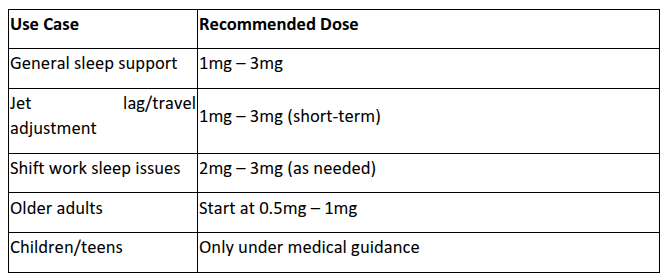
A meta-analysis published in BMC Complementary Medicine and Therapies found that doses between 0.5 mg and 5 mg were effective in reducing sleep onset time, with minimal differences between low and high doses in most adults.
Source : BMC Complement Med Ther - Dosage de la mélatonine dans l'insomnie
Pourquoi des doses plus faibles sont souvent plus efficaces
Your body naturally produces about 0.3 mg of melatonin per night, so even a 1mg supplement represents a substantial increase. Starting low helps avoid potential side effects like morning grogginess, vivid dreams, or hormonal disruption over time.
Research in The Journal of Clinical Pharmacology highlights those low doses (0.3 – 1 mg) can achieve sleep benefits without disrupting circadian rhythm or creating tolerance.

Comment ajuster votre dose
✔ Start with 1 mg to 3 mg
✔ If that’s not effective after a few days, increase by 1mg
✔ Work your way up in small installments until you find what works.
Cessez d'augmenter la dose si vous ressentez des effets secondaires (p. ex. somnolence, maux de tête).
✔ Éviter l'utilisation à long terme de doses élevées sans avis médical
For most people, the goal is to use the lowest dose that works and to take melatonin only when needed, rather than every night indefinitely.
Considérations particulières
- Older Adults: Natural melatonin production declines with age, but the body also clears melatonin more slowly. Start at 0.5mg to 1mg and increase cautiously.
- Children / Teens: Melatonin should only be used under pediatric guidance. Doses are usually lower and carefully monitored.
- Prescription Interactions: If you take medications for blood pressure, mood, or immune conditions, check with a provider before starting melatonin.
The American Academy of Sleep Medicine recommends using melatonin for short-term use or to correct a misaligned circadian rhythm, not as a daily long-term sleep aid without supervision.
Source : AASM - Prise de position sur la mélatonine

Résultat final
Most adults sleep better with 1 – 3mg of melatonin taken 30–60 minutes before bed. Start low, monitor your body’s response, and adjust only as needed. When used correctly, melatonin can be a gentle and effective sleep tool.
Explore a wide range of melatonin dosages—from microdosed tablets to 10mg time-release options—at Vitasunn Nutritionals and find what works best for you.
Frequently Asked Questions
How much melatonin should I take for sleep?
The most effective Melatonin for adults appears to be in the 1 - 5 mg range. However, the actual serving portion can vary by factors like age, body weight, and the selected product format.
What is the recommended starting dose?
Many people consider 0.5 mg as the lowest Melatonin starting dose. Beginners may administer this dosage for about a week, observing their body responses before possibly adjusting the quantities upwards.
What is the maximum safe dose?
10 mg appears to be the maximum safe melatonin dosage. Exceeding this ceiling may trigger adverse effects, including daytime grogginess and nervousness.
Is 10 mg too much?
While beginners may be tempted to overconsume higher Melatonin doses like 10 mg, reports generally suggest the supplement is most effective if moderately consumed. Stick to your baseline dosage to avoid adverse effects.
Does more melatonin work better?
No. Taking more Melatonin than recommended, or exceeding your current tolerance level, can trigger severe adverse reactions.
How does dose vary by age?
Children and teenagers may process Melatonin faster due to their rapid metabolism, with potentially dramatic effects. This age group should only take the supplement under strict medical supervision. The elderly process Melatonin much more slowly. Still, extreme caution is important to avert potential overdose.
Should I dose by body weight?
Body weight might have a marginal influence on Melatonin's efficacy in terms of the average onset time. However, greater emphasis should be on the reasons for taking Melatonin and the selected format.
Can you overdose on melatonin?
Yes. While the concept of Melatonin overdose is rather abstract because there's really no standard dosage, overconsuming the supplement may cause serious unpleasant reactions.
What if a low dose doesn't work?
If Melatonin proves ineffective at lower amounts, you may increase the doses incrementally. Just be sure to consult a professional before consuming larger quantities like 10 mg.
When should I take my dose before bed?
Many people take Melatonin 30 min - 1 hour before bed. However, fast-acting formats can kick in within 20 - 40 minutes, while timed-release options may offer delayed effects up to 2 hours.